
In the penultimate article in a series about supercomputing, Dazed & Confused technology editor Chris Hatherill assesses the just-released TOP500 world supercomputer ranking - and picks out a few surprises. Over to Chris…
Every six months, TOP500.org releases an updated list of the world fastest supercomputers, along with statistics, country-by-country breakdowns and predictions for what we can expect to see in the future. Though the top spot in the brand new ranking hasn’t changed, there are a few surprises, both individually and overall.
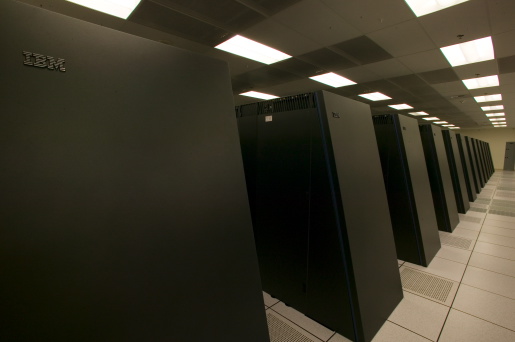
Fastest, by some margin, is the Blue Gene/L System, a joint development of IBM and the Department of Energy’s National Nuclear Security Administration that’s installed at the DOE’s Lawrence Livermore National Laboratory in California. This recently souped up supercomputer is now pushing 478.2 teraflops (that’s 478.2 trillion calculations per second), compared to 280.6 just six months ago. As we mentioned last time, BG/L’s main function is to model ageing nuclear weapons to make sure they’re safe, or, as they put it, to run “atomistic simulations of shock ejecta from copper, a fragmentation and atomization process that is very difficult to study experimentally.”
The work has won three Gordon Bell Prizes – the Oscars of supercomputing – and scientists even used BG/L to perform “the first instability simulation with a Reynolds number large enough to determine the nature of turbulence beyond the mixing transition” – a feat, they’ll have you know, that made the cover of Nature Physics magazine. We missed that issue too.
Apart from nuclear weapons research, scientists at Livermore are also working on ways to detect trace particles of explosives to make air travel safer, and complex simulations of the earth to combat climate change. A model created last year, for instance, showed that planting trees in northern latitudes might actually increase global warming – something impossible to predict without the kind of computing power now available.
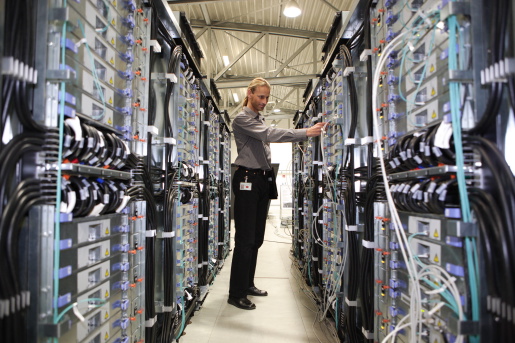
Lagging some way behind is a similar IBM system called Blue Gene/P. Installed in Germany, it hit 167.3 teraflops to take second place, ahead of the third place contender at 126.9. Forth place came as a bit of a surprise, as for the first time ever, India placed a system in the Top 10. Computational Research Laboratories in Pune, India, installed a Hewlett-Packard system, installed their own innovative routing technology and achieved 117.9 teraflops – not a bad supercomputing result for this upcoming superpower. Sweden also made a strong showing in fifth place, though the majority of the TOP500 are still based in America, followed by the UK, Germany and Japan.
Perhaps the biggest surprise, though, are the overall speeds revealed in the new rankings. The “you must be this fast to ride” cut-off moved up to 5.9 teraflops, compared to 4.0 when the last list came out six months ago. The total combine performance of all 500 supersystems grew to 6.97 petaflops (that’s quadrillions of calculations per second – a figure that sounds like Dr. Evil grappling with modern economics in Austin Powers) versus 4.92 in June. As TOP500 reports, “this turnover rate is above average.”
At this rate, it won’t be too long before an individual system breaks the petaflop barrier – something the Folding@home project can manage with the help of thousands of PS3s around the world. Next week, we’ll look at where supercomputing will go next – on a straight line to faster and faster speeds, or into the strange world of quantum physics, and – theoretically – infinitely faster supercomputers.
Now the question is will it run Doom with out chug
Comment by Carl — Nov 13, 2007 @ 5:49 pm
I love this show ^^
Comment by Justin Bailey — Nov 13, 2007 @ 6:26 pm
[i]The Sony PlayStation 3 has a number of unique features that make it particularly suited for scientific computation.Its incredibly low cost makes it very attractive as a scientific computing node, that is part of a cluster. In fact, its highly plausible that the raw computing power per dollar that the PS3 offers, is significantly higher than anything else on the market today![/i]
CELLnet doesn’t even break into a sweat hitting 478.2 teraflops running F@H n the PS3
i hear Blue Gene/P is the recommended system requirements for playing Crysis.
Comment by mobiletone — Nov 13, 2007 @ 6:46 pm
BlueGene + crysis = DROOOOL
Comment by JohnSketch — Nov 13, 2007 @ 6:55 pm
The Cell BE processor being based on IBM’s POWER architecture lends itself to a tremendous number of applications.
Even IBM cannot resist using it in their own systems and hence it’s at the heart of their QS range of blades.
This sits quite happily along side other blade models, based on other processors - such as Intel, AMD and POWER - running a nice little Linux distro.
The PS3, even with this first generation Cell BE processor, is a computational power-house and games developers have yet to tap into it properly.
I just sincerely hope that Sony does it justice and not just sell it as a cheap BluRay player.
Comment by Zed Zee — Nov 13, 2007 @ 11:32 pm
RSS feed for comments on this post. TrackBack URI
Leave a comment