
In the second of a series of articles, Dazed & Confused technology editor Chris Hatherill checks out the power of distributed computing…
Ever dreamed of discovering a new planet? Or creating artificial intelligence? How about saving the earth? Or finally cracking cancer, HIV or malaria? Back in the old days, you’d need a PhD, a labcoat and several million pounds. Today, all it takes is a PS3. By harnessing the power of the little black box under your TV (or that white one on your desk), researchers are building a new kind of ‘supercomputer’ to help solve some of the toughest problems in maths, biology, astronomy, physics and earth science. And you can help.
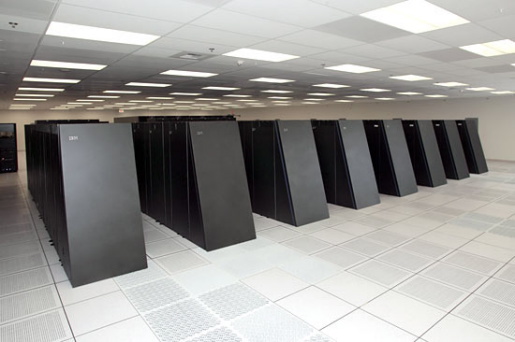
The most famous example of distributed computing is SETI@home - the long-running, headline-grabbing hunt for extraterrestrial radio signals. By breaking down data into small packets and sending them to users’ home computers to analyse, the project caught the public’s imagination in a big way when it launched in 1999. Over five million people have participated to date, each hoping to be the one to discover aliens – or possibly just drawn in by the pretty colours and scientific-looking graphics that turn your screensaver into a potential ET finder. While the objective is – let’s face it – kinda gimmicky, the numbers are very impressive. The project has logged over two million years of combined computing time, and its 1.6 million computers rival the world’s fastest supercomputer, IBM’s BlueGene/L (below).
In a way, SETI@home has been a victim of its own success. By demonstrating that millions of nerds’ computers (mine, sadly, included) could work together effectively, it paved the way for a whole whack of similar ideas ending with ‘@home’. The biggest are Einstein@home (which is searching for gravitational waves), BOINC (a network of different projects based on the SETI@home system) and Folding@home (which you can run directly from your PS3). The latter is looking into how proteins in our body ‘fold’ and combine together, something that is hard to model without a lot of computing power. The project is providing useful information that could help researchers tackle cancer, Alzheimer’s, BSE and other related diseases – and it can even run in the background without you noticing it! So far, fifty research papers have been published using the results, and as systems get faster so should the pace of progress.
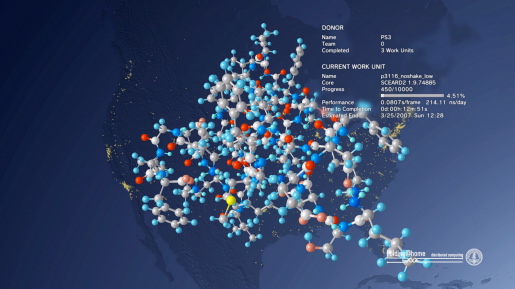
The PS3’s contribution to the project shows just how much individuals matter. After six years of Folding (and folding, and folding, and folding), the first PS3 client was launched in early 2007. With gamers – and the PlayStation’s Cell Broadband Engine – on board, the system’s performance soon peaked at 990 teraFLOPS. Old BlueGene/L, for comparison, can manage just 360. As Vijay Pande from Stanford University said at the time, “The PS3 turnout has been amazing, greatly exceeding our expectations and allowing us to push our work dramatically forward. Thanks to PS3, we have performed simulations in the first few weeks that would normally take us more than a year to calculate. We are now gearing up for new simulations that will continue our current studies of Alzheimer’s and other diseases.”
The remarkable power of distributed computing became even more apparent with the launch of a newer, faster PS3 client in April this year. Even though there are far more PCs plugged in, 76% of the calculations for Folding@home are now performed on PS3s, and the network broke through the petaFLOP barrier last month – meaning it’s doing over a quadrillion calculations per second. As Vijay Pande concludes, “Thanks to PS3, we are now essentially able to fast-forward several aspects of our research by a decade.”
Other problems you can now help tackle at home include climate change, the hunt for potentially lethal asteroids, the battle against diseases ranging from HIV to Dengue Fever and even poverty in Africa. Alternately, you can help calibrate the world’s largest particle collider, hunt for new planets beyond Pluto, crack new codes and help NASA analyse comet dust. With so many worthy projects vying for your idle processor time, it can be hard to decide.
Check out Wikipedia for a full list, or to download Folding@home direct to your PS3, just click on the Folding@home icon within the Network menu of the XrossMediaBar. Saving the world has never been so easy.
Next time: The people who invented the World Wide Web are now building a new system called The Grid. Could it turn your PS3 into the most powerful computer ever built?
I’m still waiting for my t.v. and toaster to have cell technology that i can connect to my PS£ through a network - as was advertised all those years ago - to create a mini home cluster!
Good article btw
Comment by JohnSketch — Oct 22, 2007 @ 4:14 pm
Can it tell us why Johns luck pants didn’t work for him in the recent compo?
Comment by Dan (BBRodriguez) — Oct 22, 2007 @ 4:28 pm
and why my PS3 is dusty again 0.3 micro seconds after my missus has dusted it?
Comment by Dan (BBRodriguez) — Oct 22, 2007 @ 4:30 pm
Interesting article. Inspires me to give the “folding” thing a go.
Comment by reakt — Oct 22, 2007 @ 4:36 pm
Jus an off the wall sugestion but do you think eventually they will get these things to play some decent games in the future? Just imagine!
Comment by Ton Capone — Oct 22, 2007 @ 4:36 pm
@5 Games - you must be joking!
Comment by JohnSketch — Oct 22, 2007 @ 4:50 pm
@2 and they were fresh out the wash aswell!
Comment by JohnSketch — Oct 22, 2007 @ 5:08 pm
@7
I thought I returned them to you in ‘nearly new’ condition.
Comment by mrsatansdojo — Oct 22, 2007 @ 5:20 pm
The Seti@home video reminds me of a bit in Akira for some reason.
I’d like to see my PS3 fold some other things too; envelopes, paper aeroplanes, cake mixture, etc…
Comment by mrsatansdojo — Oct 22, 2007 @ 5:30 pm
Morning all. A bit off topic this but…
Does anybody know if/when we will be getting a flash player update for the PS3?
Comment by Si Doob — Oct 23, 2007 @ 9:08 am
video has been removed
Comment by Carl Crawford — Oct 23, 2007 @ 2:32 pm
10. The PS3 broswer is made via flash. It uses a special software from adobe which is used to create applications for embeded products. It is no longer supported by Adobe, so we wont be seeing an update as they stopped at version 6 of flash.
Comment by Carl Crawford — Oct 23, 2007 @ 3:32 pm
@10
Yeah I second this, flash sites dont know what browser the PS3 is so cant direct to the correct plugins etc. I was just so looking at the Wipeout Pulse site and it wouldnt work…
Comment by Terry — Oct 23, 2007 @ 4:34 pm
Cheers 12 &13
Seems a bit strange that we won’t be able to access flash sites when EA’s Fifa site runs on flash. Nevermind, just have to fire up the old PC at home.
Comment by Si Doob — Oct 24, 2007 @ 8:53 am
RSS feed for comments on this post. TrackBack URI
Leave a comment