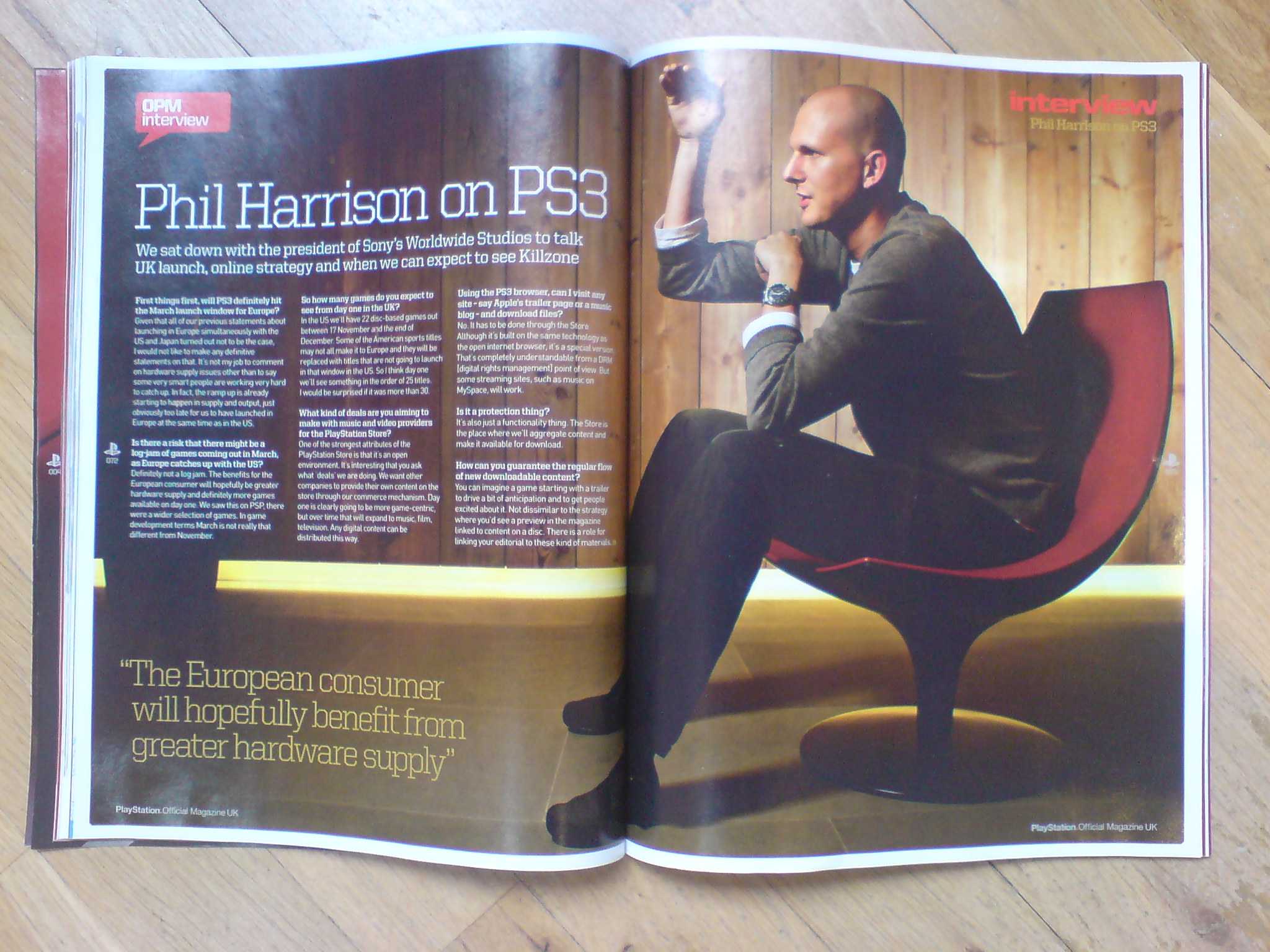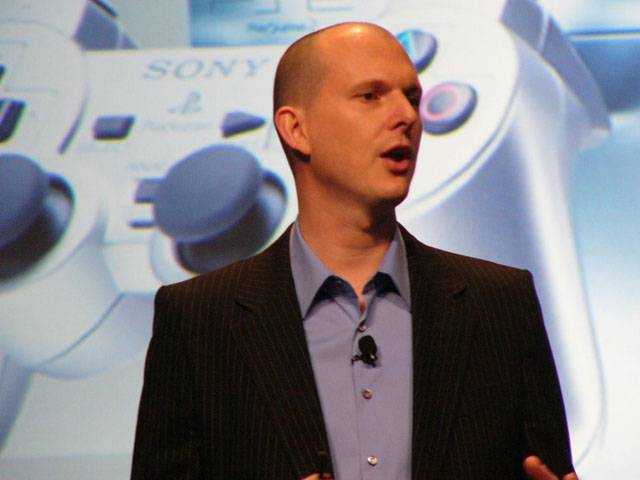
We hooked up Rob Fahey from Eurogamer.net with Sony’s head of worldwide studios, Phil Harrison, for a long and intense interview that will lead to a whole series of pieces to be published on Three Speech. Here’s the first, with Phil Harrison talking PS3 hardware.
If you were going to pick somewhere to work, this wouldn’t be a bad choice. We’re in a modern office near Oxford Circus in London, with tall glass windows all down one side which look out over the rooftops of Soho; in the distance, the London Eye turns slowly. Perhaps even more distracting than the view, though, is the giant plasma screen which dominates the office - and the PlayStation 3 which sits underneath it. Lots of offices in London have great views of the river or the city’s landmarks - very few, right now, have great views of Ridge Racer 7, which is what’s on screen at the moment.
We’re in Phil Harrison’s office, and we’re here to talk about the PS3. Sony may be a Japanese company at heart, but if you’ve got questions about the forthcoming console and its software, this is the right place to come. Since he was appointed as head of Sony’s worldwide studios - the guy in charge of software, in other words - Harrison has become the company’s straight talker. There are plenty of people you can talk to if you want visionary, non-specific babble about the entertainment systems of the future. You talk to Phil Harrison if you want a straight answer about why the hell Sony is insisting on a Blu-Ray drive for PS3, or what they were thinking when they dropped rumble from the pad.
So we ask those things…
First things first. Blu-Ray, the disc system which the PS3 uses, is probably the most controversial aspect of the console. The discs, which are the same size as DVDs, can hold either 25 or 50GB of data - compared to 4.7 or 9GB on DVDs. That’s great, but less great is the fact that the inclusion of the drive is believed to be responsible for much of the cost of the console, and Sony admits that Blu-Ray shortages are behind the decision to delay the European launch of PS3 to 2007. What’s more, Sony has been accused of putting the drive into the console just to drive sales of high-definition movies on Blu-Ray discs - effectively making consumers pay for a Hi-Def movie player in their console, whether they want one or not.
So what’s the real reason for Blu-Ray being in every PS3? Are people who just want to play games, and aren’t bothered about Blu-Ray movies, really going to see any benefits?
“Well, they’re going to get, in their console, not just the movie format but the data transport format - which will be at least the next ten years,” Harrison explains. “DVD is not sufficient capacity to power the kind of data consumption, or to feed the data consumption needs of Cell and RSX. It’s got nothing to do with movies. Just purely as a gameplay device, we need Blu-Ray to supply the kind of data that PS3 games use.”
“It’s not just about graphics - it’s about 7.1 audio, it’s about speech, it’s about having up to 1080p movies built into the game; it’s high res textures, it’s animation, it’s everything that goes into making a very rich and varied next-gen experience. Already, at our launch titles, we’re getting up close to the 25GB limit that we have on our Blu-Ray discs this year. Next year we’ll raise that to 50GB, and I’d expect that we’ll be getting close to that in the fairly near future as well.”
“Don’t take my word from it - there was a great quote from a guy from EA who said that whenever there’s a new disc format, you always struggle to think how developers will fill it, but they always do. I suppose that game development is like gas, it expands to fill the available space. Once you have that technical capability, the creative desire to exploit it follows very quickly thereafter.”
One of the things that people are concerned about is that discs will be filled with high-resolution video scenes rather than actual game content - which seems like a fair concern, since at the moment game creators seem to be fitting next-gen titles perfectly well onto DVDs. The question, then, is whether there’s relevant, interactive content that is going to need this sort of disc.
“Absolutely,” Harrison says. “I mean, not every game is going to fill 25 or 50GB. I completely accept that - but there will be games that require that this year, and will push that further in years to come. It’s not just, as you say, about movies - it’s about 7.1 audio, it’s about animation, it’s about high resolution textures. If you have a graphics chip capable of displaying the textures in a high enough resolution, the designers would want to exploit that benefit creatively.”
“So partly it’s visual, partly it’s sound, and partially it’ll be down to gameplay benefits as well - more levels, more detail, richer experiences. Also, I see nothing wrong with having non-interactive, full HD sequences as part of the game - that’s all part of the production value and the experience that you get when you buy the game. I don’t see that as a weakness at all.”
One spanner in the works, though, is Sony’s own announcement a few weeks ago that it’s going to be shipping some games where you buy a cheap disc with relatively little content on it, and then download more content over the network as you go along. Two titles like that are Singstar and Gran Turismo HD - which begs the question, what do you need a Blu-Ray disc for if you’re just going to be downloading everything and storing it on the PS3 hard drive? Doesn’t that make the whole Blu-Ray idea a bit, well, irrelevant?
Not so, says Harrison. “Both of the games that you cite there will have very large databases of content on the disc - I don’t know exactly how big today, but definitely way more than anything we can do on DVD,” he says. “Then, those games will be extended and expanded via downloadable content, which will be added to the user’s hard drive.”
“There will be games that start off relatively small, in terms of initial disc capacity, and then the users can extend and expand the experience by downloading content. What that allows us to do as a publisher is perhaps a year after, or two years after, we can take all of that downloadable content and put it onto the disc, and republish, or add value, or some other incentive, to the consumers who didn’t buy first time around - so that gives us plenty of future proof options for how we deliver content to users. All of that is only possible because of Blu-Ray.”
Out of space. Check back on Three Speech soon for Harrison’s reply to our questions about rumble in the PS3 pad - and why Sony has added a HDMI video port to the low-end PS3 system at the eleventh hour!
By Rob Fahey (Eurogamer.net)